LOUISE Laboratory Members Publish Two Q1 Papers
Members of the LOUISE Laboratory have published two papers in the IEEE Access journal, indexed in WoS and Scopus, ranked as Q1.
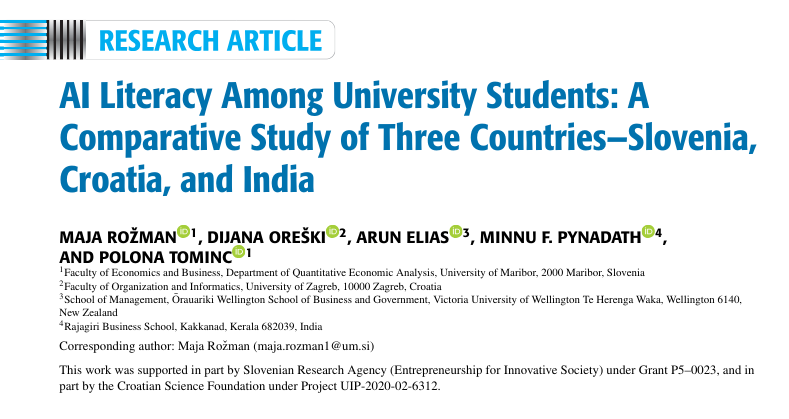
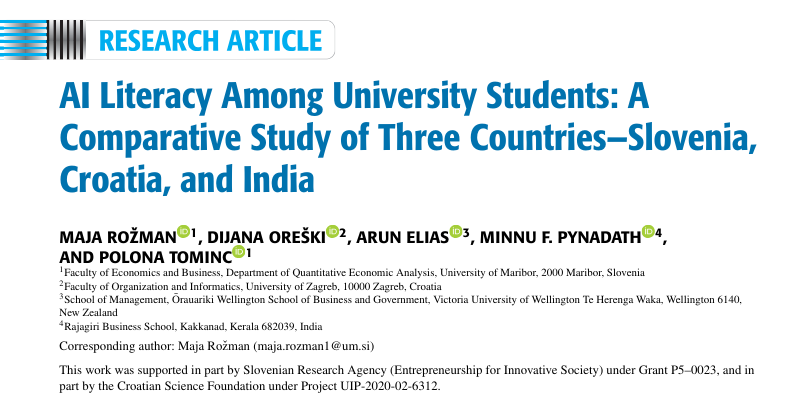
The paper “AI Literacy Among University Students: A Comparative Study of Three Countries – Slovenia, Croatia, and India” (available here) explores the level of AI literacy among students across three different educational and cultural contexts. It analyzes how well students understand fundamental concepts of artificial intelligence, its capabilities, risks, and ethical aspects, and how their knowledge and attitudes vary depending on the country and study program. For LOUISE, this paper is particularly relevant as it highlights the importance of AI education and the development of AI competencies, aligning with the lab’s mission to make artificial intelligence accessible to a broader community through workshops, research, and interdisciplinary projects. The study’s results can serve as a foundation for designing educational programs and initiatives that contribute to raising AI literacy in higher education and society.
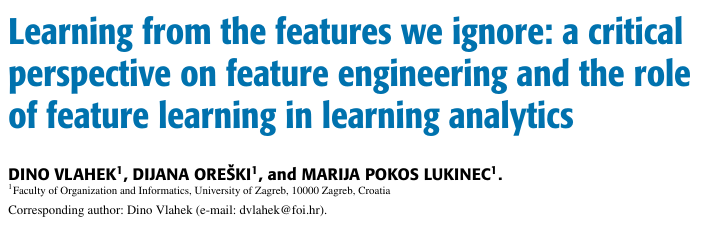
The second paper, “Learning from the Features We Ignore: A Critical Perspective on Feature Engineering and the Role of Feature Learning in Learning Analytics” (available here) authored by Dino Vlahek, Dijana Oreški, and Marija Pokos Lukinec, provides a critical analysis of the role of feature selection and engineering in data-driven learning systems. The authors examine how traditional manual feature selection methods differ from modern approaches using AI and deep learning, while highlighting risks such as bias and loss of model interpretability. For LOUISE, this study is significant because it addresses the transparency and explainability of AI models, one of the lab’s key research areas. It emphasizes the need to develop methods that allow for understandable and ethically responsible use of data, particularly in the context of AI systems applied in education and learning analytics - domains in which LOUISE actively works through research and educational projects.
Image Gallery